Most B2B companies pick the wrong ecommerce model.
They see what Amazon Business or Alibaba is doing and try to copy it and without realizing those platforms are built for a completely different business structure than theirs.
The result? A portal that doesn’t fit how their buyers actually purchase. Low adoption. Frustrated customers. Wasted budget.
In this guide, I’m going to break down EXACTLY how each B2B ecommerce model works, which industries they’re built for, and how to figure out which one is right for your business.
Let’s dive right in.
The 4 Core B2B Ecommerce Models
There isn’t one “B2B ecommerce.” There are five distinct models, each built around a different relationship between buyers and sellers.
Understanding which model fits your business is the most important decision you’ll make before building a digital channel.
Here they are.
Model #1: The Seller-Centric (Sell-Side) Portal
This is the most common model for manufacturers and distributors.
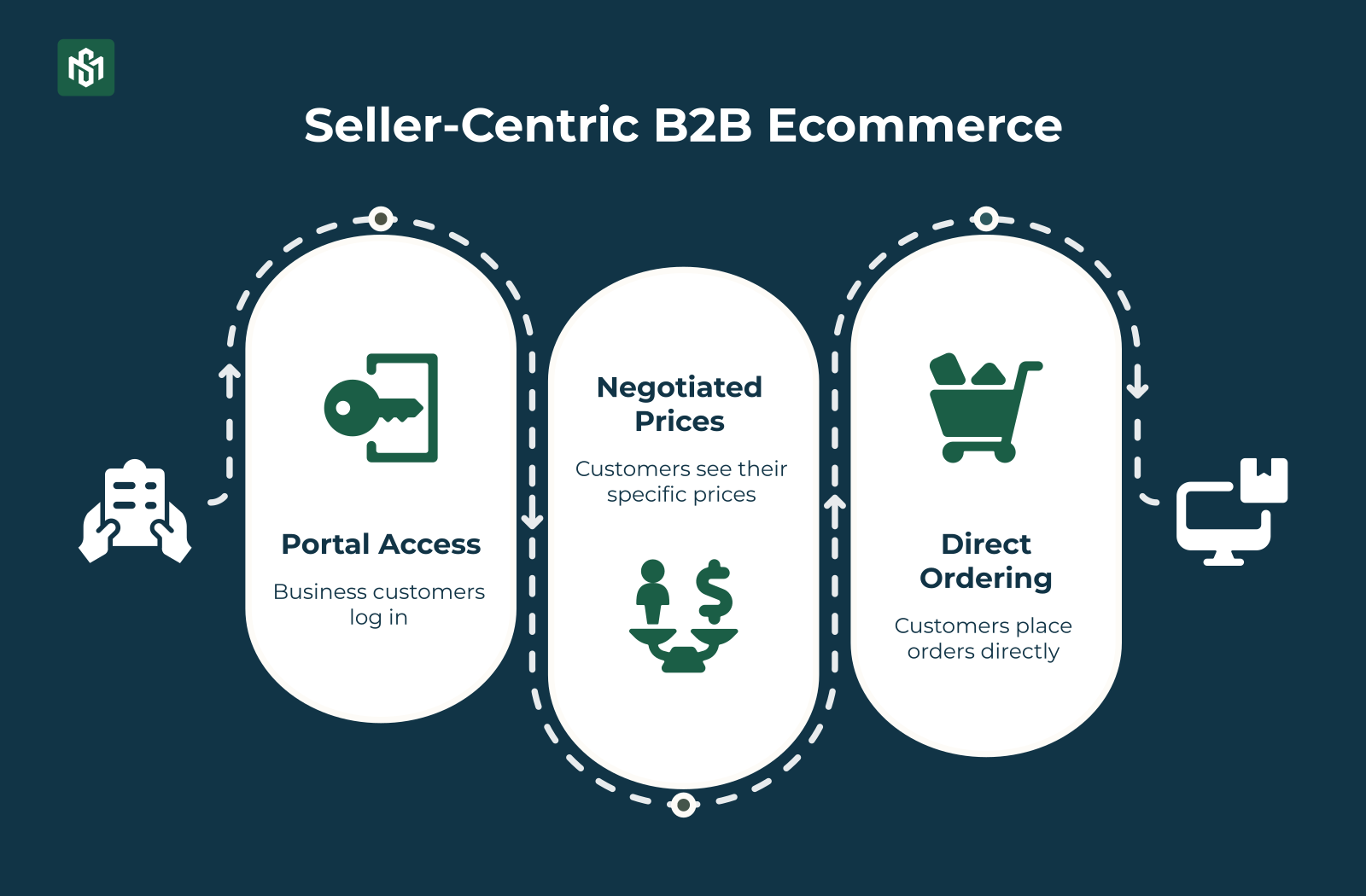
One company or a small group of suppliers runs an online portal. Business customers log in, see their negotiated prices, and place orders directly.
Think of it as a one-to-many online catalog with contract pricing, account-based terms, and tight integration into the seller’s back-office systems.
Real-world Examples
Grainger: A large industrial supplier whose B2B portal lets businesses buy MRO (maintenance, repair, operations) supplies with negotiated prices and punch-out integration into buyers’ procurement systems.
This model gives you full control over your brand, pricing, and customer data.
The tradeoff? You’re responsible for driving traffic and adoption. Buyers don’t stumble onto your portal, so you have to bring them there.
Model #2: The Buyer-Centric (Buy-Side)
Flip the seller-centric model around and you get this.
Here, a large buyer or group of buyers runs its own procurement portal and invites approved suppliers to connect. All internal departments must purchase through this system.
The buyer gains central control over prices, approved suppliers, and compliance.

Real-world Examples
A large university that builds a private portal where office-supply, lab-equipment, and IT vendors list their products and every department must order through it.
Large enterprises use e-procurement platforms to aggregate multiple suppliers into one interface, manage budgets, and enforce spending policies across thousands of employees.
This model is HUGE for large organizations because it eliminates maverick buying (employees purchasing from unapproved vendors at uncontrolled prices) and cuts procurement costs dramatically.
Model #3: The Intermediary Marketplace (Multi-Seller, Multi-Buyer)
This is what most people picture when they think “B2B ecommerce.”
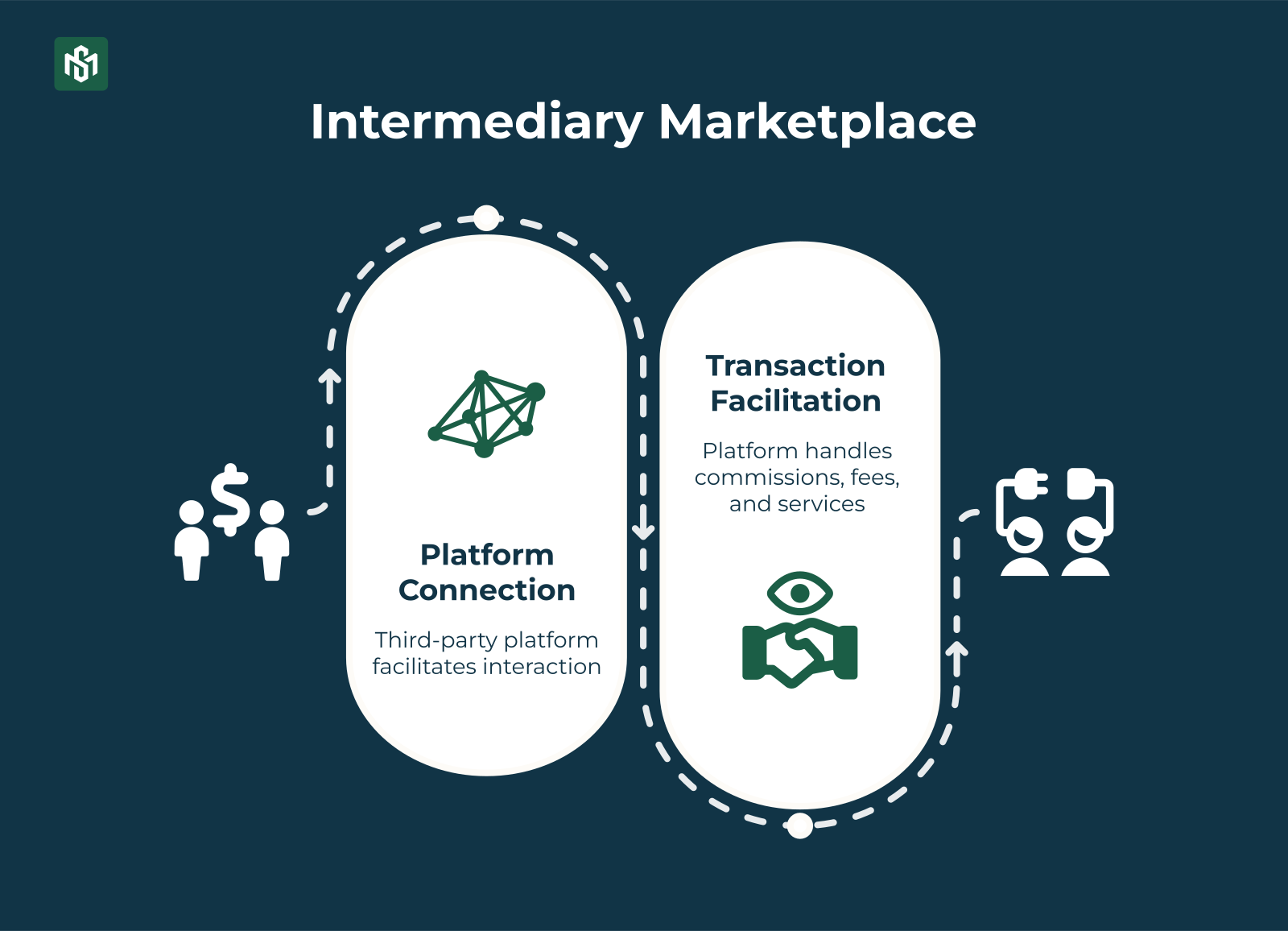
A third-party platform connects many sellers with many buyers and earns revenue through commissions, fees, or value-added services like logistics and payments.
These platforms can be vertical (focused on one industry) or horizontal (many categories across industries).
Real-world Examples
- Alibaba.com: A horizontal, global B2B marketplace connecting international buyers with mostly Asian manufacturers across every category imaginable. The largest B2B marketplace in the world.
- Amazon Business: Amazon’s B2B layer offering bulk purchasing, business-only pricing, and tools like multi-user accounts and approval workflows.
The advantage: instant reach. Buyers are already there.
The disadvantage: you’re competing on price, you lose customer data, and the platform takes a cut of every transaction.
Model #4: Private Industrial Networks
This is the model that moves the most money in B2B and almost nobody talks about it.
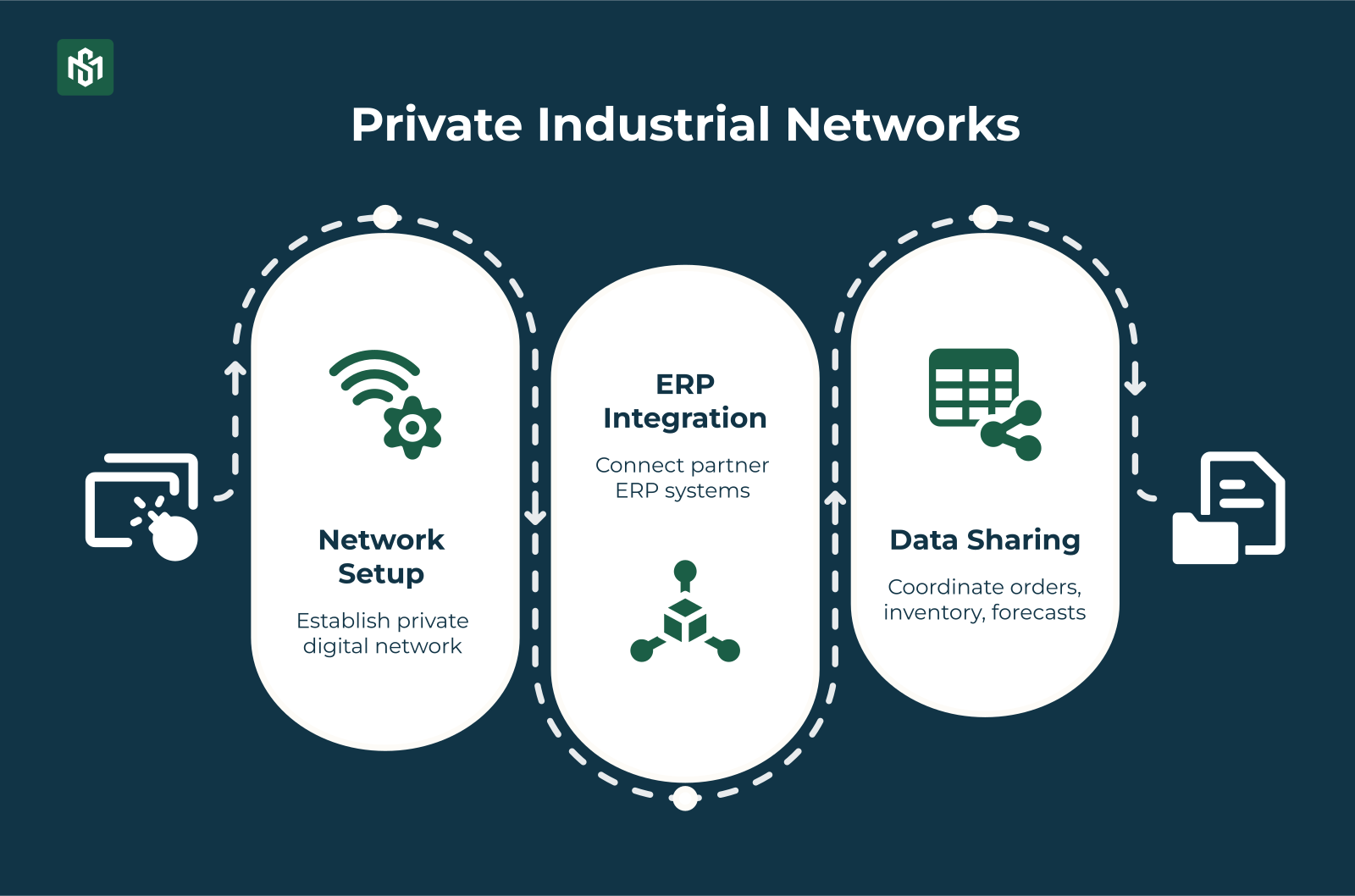
A private industrial network (also called a private trading exchange or PTX) is a closed digital network set up by one large buyer and its key suppliers to coordinate orders, inventory, forecasts, and design data.
These networks are tightly integrated with all partners’ ERPs and supply chains.
Real-world Examples
The Walmart–Procter & Gamble network: a classic private industrial network where real-time sales and inventory data from Walmart stores automatically trigger replenishment orders at P&G.;
No manual ordering. No emails back and forth. The system just works and it’s why P&G; products are almost never out of stock at Walmart.
Similar proprietary portals are used by large manufacturers to collaborate with tier-1 and tier-2 suppliers across forecasting, ordering, and logistics.
These networks account for a massive share of big-company B2B spending precisely because they eliminate friction at every step of the supply chain.
5 Key Characteristics Every B2B Ecommerce Platform Must Support
Regardless of which model you run, B2B ecommerce platforms share a set of features that are non-negotiable.
These aren’t nice-to-haves. They’re what separates a real B2B platform from a B2C store with a “business pricing” tab bolted on.
Multi-Stakeholder Buying Process
B2B purchases involve several decision-makers like procurement, finance, technical teams, management.
Your platform must support multiple user roles and approval workflows on the buyer side. A single “checkout” button doesn’t cut it.
Customer-Specific Pricing
B2B pricing is negotiated per customer or contract. Different accounts see different prices, discounts, and payment terms when they log in.
This alone disqualifies most standard ecommerce platforms for serious B2B use cases.
Approval and Workflow Automation
B2B systems need budgets, approval chains, and purchasing limits. Plus automated workflows, quote-to-order, order-to-invoice to eliminate manual work at scale.
Deep System Integration
Successful B2B ecommerce integrates with ERP, CRM, inventory, and logistics systems. Stock levels, prices, and invoices stay synchronized in real time.
Without this, data mismatches on high-value orders destroy customer trust fast.
Security, Compliance, and Documentation
B2B transactions are high-value and sensitive. Platforms must enforce strong authentication, role-based permissions, and secure data handling.
And every transaction generates formal documents like quotes, contracts, purchase orders, invoices that must align with internal policies and industry regulations.
Which Model Is Right for Your Business?
Here’s the practical breakdown, just the model that actually fits each business type.
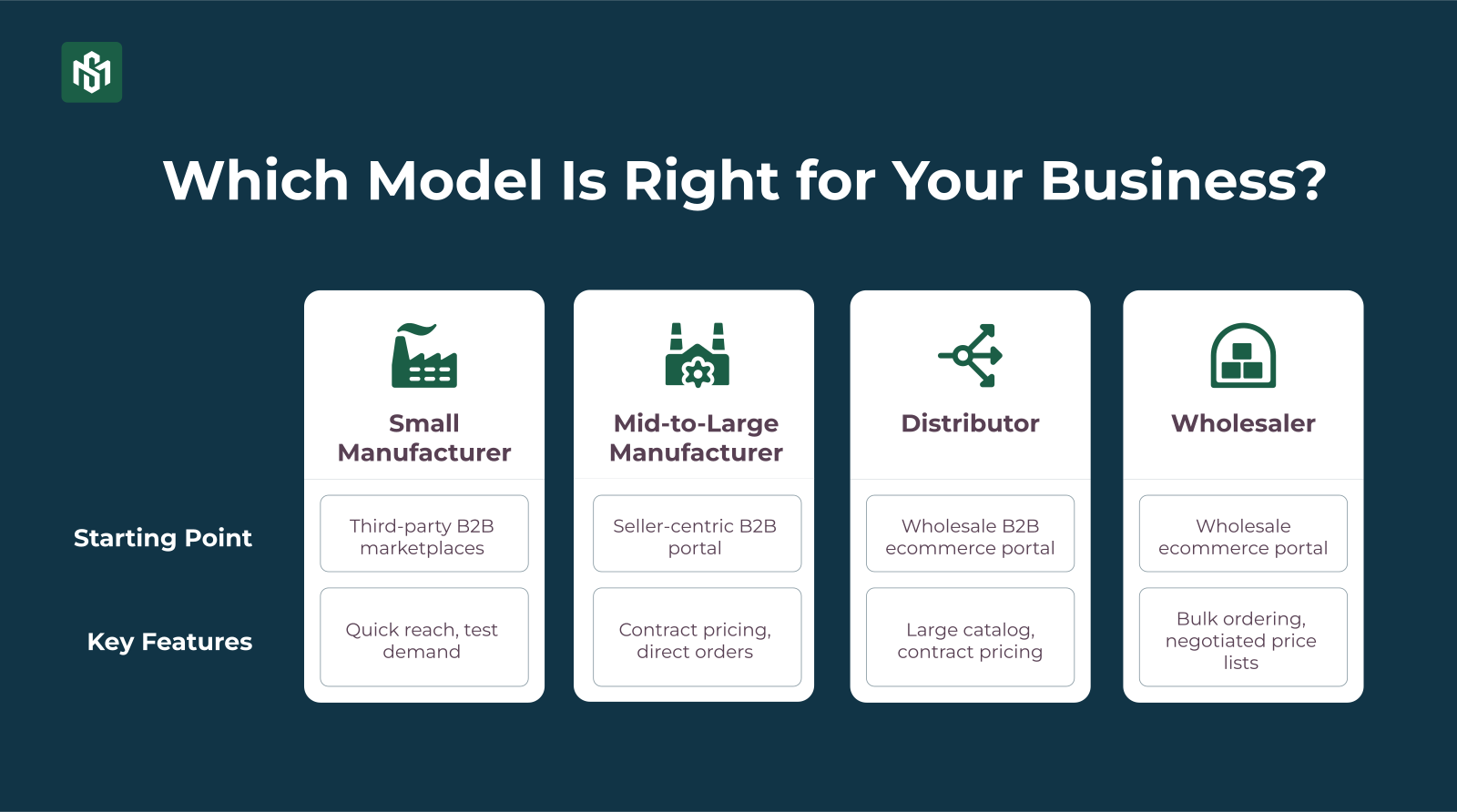
Manufacturers
- Small or new manufacturer?
Start with third-party B2B marketplaces like Alibaba, industry platforms to get reach quickly and test demand with lower up-front investment.
As you grow, add your own seller-centric B2B portal to control branding, pricing, and customer data. Keep the marketplace as an additional channel.
- Mid-to-large manufacturer?
Run your own seller-centric B2B portal as your core channel. Dealers, distributors, and large end-customers log in, see contract pricing, and place orders directly.
Add marketplace participation to reach new regions or customer segments — but your portal is the primary relationship.
Distributors
Your core model is a wholesale B2B ecommerce portal: a large-catalog B2B store with contract pricing, customer groups, and credit terms.
The platform needs to handle different customer groups, complex pricing tiers, and multi-warehouse inventory.
Wholesalers
Same playbook as distributors: a wholesale ecommerce portal with bulk ordering, negotiated price lists per account, and easy reorder tools.
For enterprise chain customers (large retailers, supermarkets), you’ll also need to plug into their buyer-centric e-procurement systems. But that’s a secondary channel, not your own model.
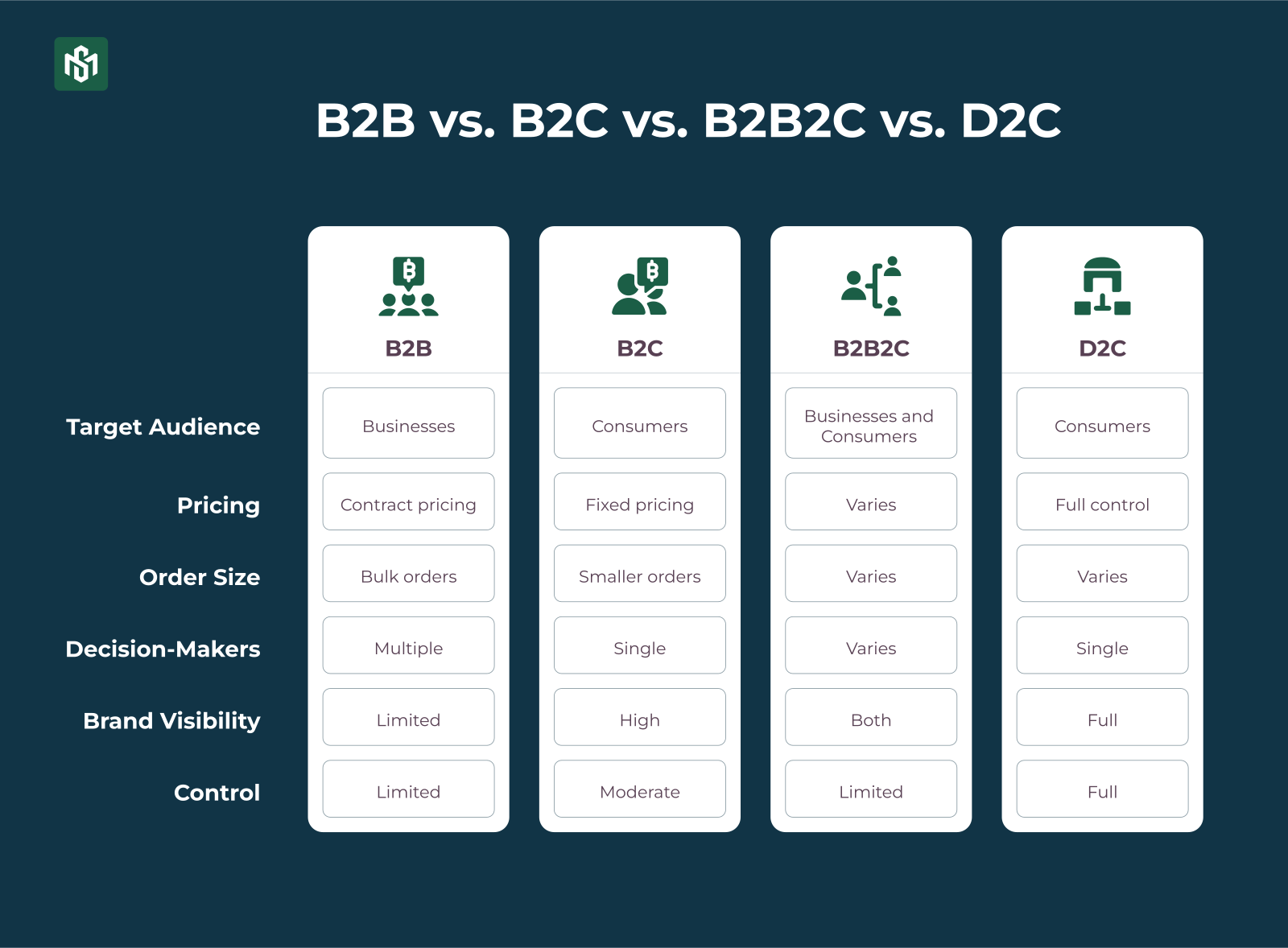
B2B vs. B2C vs. B2B2C vs. D2C: The Clearest Breakdown
These four models get confused constantly, especially B2B2C and D2C, which sound similar but operate very differently.
Here’s EXACTLY how each one works.
B2B (Business to Business)
One business sells to another business via online channels.
- Traits: Contract pricing, bulk orders, multiple decision-makers, account-based portals.
- Example: A chemical manufacturer’s portal where factories log in, see negotiated prices, and place pallet-size orders.
B2C (Business to Consumer)
A business sells directly to individual consumers online.
- Traits: Public catalog, fixed pricing, marketing to individuals, simple checkout, smaller orders.
- Example: A fashion brand’s online store selling directly to end customers.
B2B2C (Business to Business to Consumer)
A business sells to another business and together, they deliver to the final consumer, with the original brand still visible.
- Traits: The consumer sees and interacts with both brands, even though the transaction flows through an intermediary.
- Example: A food manufacturer selling through a delivery app where consumers see the manufacturer’s brand but order via the platform.
D2C (Direct to Consumer)
A brand or manufacturer sells straight to the end consumer, bypassing distributors and retailers entirely, usually via their own ecommerce site.
- Traits: Full control of brand, data, and pricing. Often combined with social media and subscription models.
- Example: A mattress manufacturer selling only through their own website, shipping directly from factory to consumer.
The Bottom Line
There’s no single “right” B2B ecommerce model.
The right model depends on who you are in the supply chain, how your buyers want to purchase, and how much control you want over pricing, data, and relationships.
Manufacturers building long-term dealer relationships need their own seller-centric portal. Distributors scaling across thousands of accounts need a robust wholesale platform. Large buyers want an e-procurement system that locks in compliance. And the biggest players in any industry end up building private networks with their key partners.
Start with the model that fits your business today. Build toward the model that fits where you’re going.